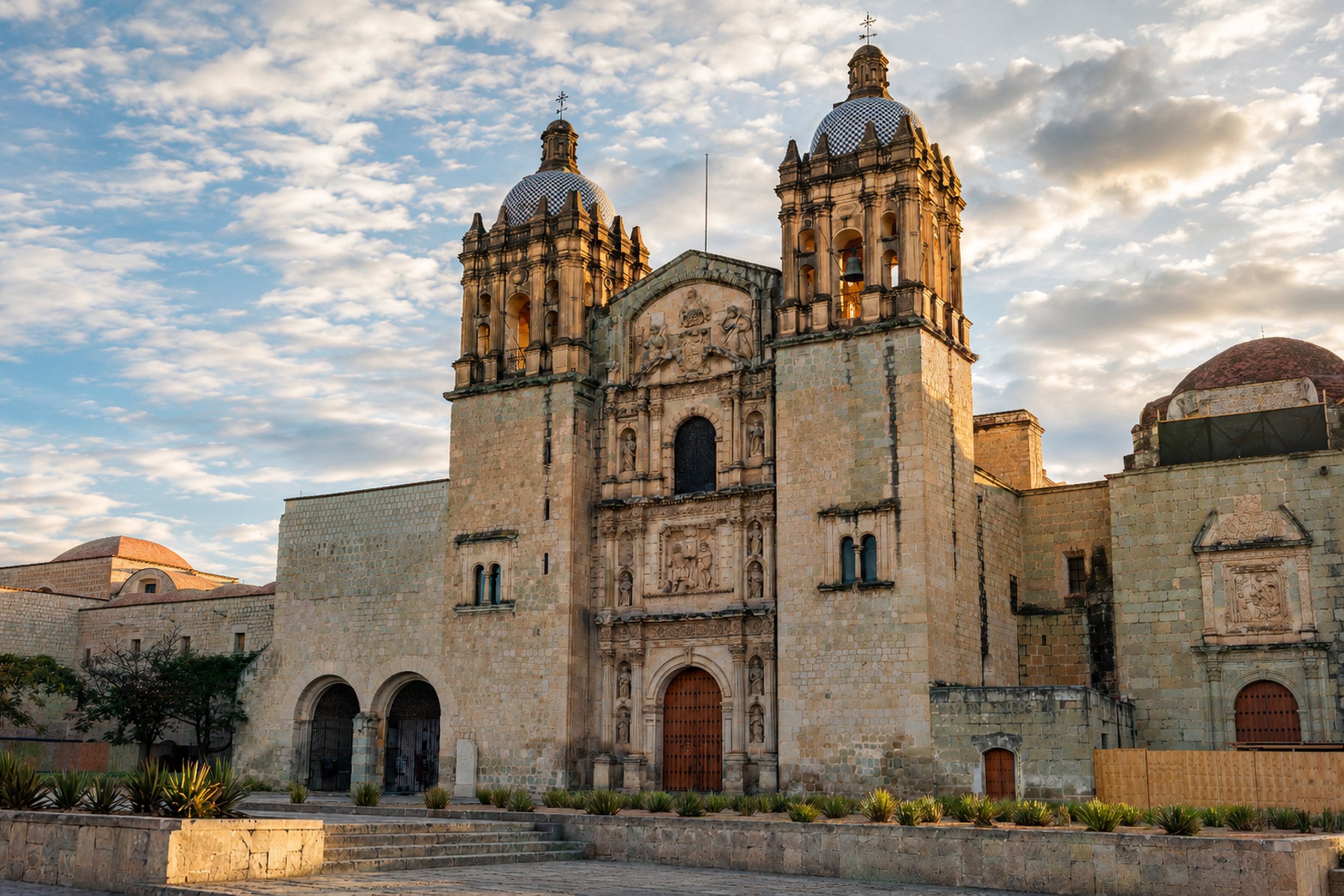
The best day trips from Oaxaca are not the longest ones. They are the ones that give a place enough time to become more than a stop on a van route.
I learned this early. In my family, a day outside the city was never just "go see the village." It was leaving before the heat hardened the streets, buying something to eat on the way, greeting people properly, and understanding that a rug, a pot, a mezcal, a market, or a ruined city carries more history than a quick photo can hold. Oaxaca does not become richer because you add more stops. Often, it becomes thinner.
For most travelers, the strongest day trips from Oaxaca City are Monte Albán, Mitla with the eastern valley, Hierve el Agua, Teotitlán del Valle, Tlacolula Sunday market, the mezcal route around Santiago Matatlán, and a southern craft route through villages such as San Martín Tilcajete, San Bartolo Coyotepec, Santo Tomás Jalieza, and Ocotlan. The Sierra Norte can also work, but it asks for a longer, more outdoorsy day.
Fast answer:
| Day trip | Best for | Realistic timing from Centro | What to watch |
|---|---|---|---|
| Monte Albán | First-time archaeology, valley views, Zapotec history | Half day | Heat, limited shade, guide quality |
| Mitla + Tule + Teotitlan | A classic eastern valley route | Full day | Too many add-ons can make it shallow |
| Hierve el Agua | Landscape, hiking, mineral pools | Long half day or full day | Crowds, road / access changes, water levels |
| Tlacolula Sunday market | Food, textiles, living market culture | Half to full day | Crowds, pickpockets, photo etiquette |
| Santiago Matatlán mezcal route | Agave, palenques, tasting | Half to full day | Do not drive after tasting |
| Southern craft villages | Alebrijes, black pottery, looms, market towns | Full day | Sales pressure and rushed workshops |
| Yagul or Dainzu | Quieter archaeology | Half day or paired with Mitla | Less interpretation on site |
| Sierra Norte villages | Forest, hiking, cool air | Very long day or overnight | Curves, weather, community booking |
Last reviewed: May 24, 2026. Recheck official site hours, access rules, road conditions, protest / blockade news, weather, and recent tour reviews close to your travel date.
How To Choose The Right Oaxaca Day Trip
Choose by theme, not by quantity. The central mistake is booking a route that sounds generous because it lists six places, then discovering that each stop is a short walk, a bathroom break, or a sales room.
| If you want… | Choose | Skip or save |
|---|---|---|
| The essential first trip | Monte Albán | Combining it with a rushed valley loop |
| Architecture and craft | Mitla + Teotitlán del Valle | Trying to add every artisan village |
| The famous landscape photo | Hierve el Agua early | Arriving after lunch with peak crowds |
| A living market | Tlacolula on Sunday | Photographing people without permission |
| Mezcal with context | Santiago Matatlán with a driver | Driving yourself after tastings |
| Handmade work | One or two craft villages | Bargaining as if the labor has no value |
| Mountain air | Sierra Norte | Returning after dark on tired roads |
I would rather you do one route well than three badly. A good day in Oaxaca has space for silence: the sound of a loom, a guide explaining a stone relief, the smell of roasted agave, the slow decision of whether a piece belongs in your home. If the itinerary has no room for that, it is probably built for the operator, not for you.
Current Reality Before You Book
Oaxaca day trips are usually safe and rewarding, but they are not friction-free. This is a real state with real politics, mountain roads, community land, heat, rain, and tourism pressure.
Site hours and fees change.INAH listed Monte Albán and Mitla as open daily from 8:00 a.m. to 5:00 p.m. in its January 2026 updates, with last access at 4:00 p.m. for Monte Albán and 4:30 p.m. for Mitla. INAH also listed 2026 entry at 210 pesos for foreign visitors and 105 pesos for Mexican nationals and foreign residents. Treat those as a planning reference, not a promise; verify before publication or before you go.
Roadblocks can affect plans.Oaxaca has frequent demonstrations and blockades. They are not usually aimed at travelers, but they can delay airport transfers, buses, and day trips. Local reporting in May 2026 covered CNTE mobilizations and possible road blockades beginning May 25, 2026, after several earlier weeks of transport disruptions. Ask your hotel or driver the evening before any long route.
Recent traveler patterns are mixed.Monte Albán tours are often reviewed well when the guide is strong, because the site has limited interpretation if you arrive cold. Hierve el Agua gets praised for the view but also criticized when tours arrive late, cram in shopping stops, or give too little time at the pools / trails. Craft-village tours divide travelers: some love the workshop access, while others feel trapped in demonstrations built mainly to sell. The difference is usually pace and honesty.
Weather matters.The ruins and eastern valley can feel harsh in late morning heat. Rainy season brings greener hills and beautiful skies, but also wet roads, slippery stone, and occasional route changes. Mountain routes deserve extra caution after heavy rain.
Cultural respect is not optional.Villages are not displays. Ask before photographing people or private workshops. Do not interrupt ceremonies. Buy directly when you can. Pay fair prices. A handwoven rug, carved figure, or black-clay pot is not a disposable souvenir.
1. Monte Albán
Monte Albán is the day trip I would choose first for most visitors. It sits above Oaxaca City, close enough that the ride feels simple, but high enough that the valley opens around you like a map made of mountains.
This was the former capital of Zapotec culture and one of the great cities of Mesoamerica. INAH notes that it was founded around 500 B.C. and functioned as a Zapotec capital until about A.D. 800, later receiving Mixtec influence. Those facts matter, but the emotional force of Monte Albán is spatial. You stand in the Great Plaza and understand that this was not a decorative ruin. It was a city, a political center, a sacred landscape, and a statement of power.
Go early. The site has broad exposed stone, limited shade, and a kind of dry brightness that becomes tiring faster than visitors expect. Bring water, a hat, sunscreen, and shoes with grip. If you are sensitive to altitude or heat, take the site slowly.
A guide is useful here. You can visit alone and still be moved, but a good guide helps you read Building J, Los Danzantes, the ball court, tomb history, and the relationship between the city and the valley. A weak guide turns it into dates and stones. Read recent reviews by name if possible.
Best ways to do it:
| Option | Best for | Notes |
|---|---|---|
| Guided half-day tour | First-timers | Good balance if the guide has real archaeological context |
| Taxi / driver | Independent travelers | Ask about wait time and return plan before leaving |
| Private guide + driver | Families, history lovers | Worth it if you want slower pacing |
I would not combine Monte Albán with Hierve el Agua in one day unless you enjoy being moved around more than learning. Monte Albán deserves a morning, then a quiet lunch, a museum, or a slow afternoon in the city.
2. Mitla, Tule, Teotitlan, And The Eastern Valley
The classic eastern valley route usually includes Santa Maria del Tule, Teotitlán del Valle, Mitla, and sometimes Tlacolula, a mezcal stop, or Hierve el Agua. It can be excellent. It can also become the most overpacked day of your trip.
Mitla is the anchor if you care about architecture. INAH identifies the Zapotec name Lyobaa with meanings connected to rest, tomb, or burial, and the site is famous for its limestone mosaics and geometric grecas. The beauty is precise, almost woven into stone. It is a different feeling from Monte Albán: less imperial in scale, more intimate and intricate.
Santa Maria del Tule is quick but worthwhile if your route passes by. The famous tree is extraordinary, but it is not a full day. Treat it as a pause: shade, church, photo, maybe a snack, then move on.
Teotitlán del Valle is where the day can deepen. Oaxaca tourism describes it as a town known for wool textiles, wooden looms, and natural dyes such as cempasuchil, cochineal, and indigo. The best visits are not only shopping. They explain sheep wool, carding, spinning, dyeing, design, and family workshop traditions. If you enter a home workshop, enter as a guest.
Tlacolula belongs especially on Sunday, when the market becomes one of the strongest experiences in the valley. It is busy, loud, fragrant, practical, and not arranged around you. This is why it is beautiful. Eat something, watch where you stand, and ask before photos.
Best route ideas:
| Route | Good pacing | When to choose it |
|---|---|---|
| Tule + Teotitlan + Mitla | Strong full day | First-time eastern valley route |
| Tlacolula Sunday + Teotitlan | Market and textiles | Food / culture travelers |
| Mitla + Yagul or Dainzu | Archaeology focus | Travelers who want quieter sites |
| Mitla + mezcal | Culture plus palenque | Only with a non-drinking driver |
What I would avoid is the route that promises Tule, Teotitlan, Mitla, Hierve el Agua, mezcal, lunch, and shopping with a short day and a low price. Something will be rushed. Usually everything.
3. Hierve el Agua
Hierve el Agua is beautiful, but let us say the honest part first: it is not a secret, the pools are not hot springs in the way many travelers imagine, and the experience depends heavily on timing.
The name means "the water boils," but Oaxaca tourism notes the water is only slightly warmer than the air, roughly 22 to 25 degrees Celsius, well below boiling. The magic is not heat. It is the mineral water, the petrified waterfall formations, and the way the valley drops away beneath the pools.
Go early if you can. Many standard full-day tours visit other stops first and reach Hierve el Agua when the sun is high and the pool area is busiest. Recent traveler reviews repeatedly reward tours that prioritize early arrival or give enough time to walk, while complaints often mention rushed timing, unclear meeting points, or too little time once there.
Expect changing conditions. Water levels, clarity, access rules, community fees, road conditions, and crowd control can shift. The area has bathrooms, dressing rooms, palapas, small fondas, and lodging options listed by Oaxaca tourism, but do not assume every service will feel polished on the day you arrive.
Best for:
- Travelers who want landscape and photos, not only archaeology.
- People who are comfortable with a longer drive.
- Visitors willing to start early.
- Hikers who want to see the formations from below, if conditions allow.
Watch out for:
- Slippery stone near water.
- Strong sun and little shade.
- Crowds around the pool edge.
- Tour descriptions that hide entrance fees or add too many stops.
- Motion sickness on curving roads.
I like Hierve el Agua most when it is treated as a landscape, not a checklist trophy. Walk a little. Look at the valley. Eat something simple. If you only go to recreate a photo, Oaxaca may give you a busload of people standing exactly where you wanted to stand. She has a sense of humor like that.
4. Mezcal Route Around Santiago Matatlán
The mezcal route is one of the most misunderstood day trips from Oaxaca. Too many visitors arrive thinking mezcal is just smoky tequila with better branding. A good palenque visit corrects that quickly.
Around Santiago Matatlán and the eastern valley, you can see maguey fields, roasting pits, tahonas, fermentation vats, copper or clay distillation, and family-run production. Oaxaca tourism's mezcal route highlights places such as Tule, San Jeronimo Tlacochahuaya, Teotitlán del Valle, Tlacolula, Mitla, and Santiago Matatlán, but do not treat the route as something you must consume whole.
Choose one or two palenques with enough time for context. Ask about agave varieties, maturity, land use, cooking, fermentation, and how the family sells. Drink less than is poured if you want to remember what you learned.
Most important: do not drive yourself after tastings. Mezcal tasting is generous by nature, and the roads back to the city are not the place to discover your limits. Hire a driver, book a well-reviewed tour, or assign a true non-drinking driver.
Good mezcal tour signs:
- The guide explains production, not only labels.
- The route includes food or enough time to eat.
- The group is not huge.
- Tasting expectations are clear.
- Sales pressure is reasonable.
- The return plan is boring and safe.
Weak mezcal tour signs:
- Vague palenque names.
- "Unlimited tasting" as the main selling point.
- Too many stops before or after alcohol.
- No clear lunch plan.
- No explanation of who benefits from purchases.
Mezcal comes from land, water, labor, plants, and time. Treat it that way and the day becomes much more interesting than a tasting flight.
5. Teotitlan Del Valle As A Slow Day
Teotitlán del Valle is often treated as a stop between bigger names. I think it can be the whole point.
The town is known for wool rugs and textiles, but the best workshops help you understand how color is made: cochineal brightening into red, indigo moving toward blue, cempasuchil warming yellows, pomegranate and other materials creating more subtle tones. The rhythm of a wooden loom is not loud, but once you hear it you understand why a handmade piece cannot be priced like a factory object.
A slow Teotitlan day works well for travelers who want craft, food, and conversation more than distance. You can visit a workshop, eat in town, see the church area, ask about the community museum if open, and perhaps add San Jeronimo Tlacochahuaya or Tule if the day needs a second stop.
Etiquette:
- Ask before photographing people, tools, looms, or unfinished work.
- Do not touch textiles without permission.
- Ask who made a piece and what materials were used.
- Pay a fair price if you buy.
- If you do not buy, thank people for their time.
Some visitors complain that workshop tours feel staged. Sometimes they are. But the answer is not to dismiss the craft; it is to choose better, smaller, more transparent visits and give the place time to speak in its own rhythm.
6. Tlacolula Sunday Market
Tlacolula on Sunday is not a polished tourist attraction. It is a living market, which is why it matters.
People come for barbacoa, bread, produce, textiles, baskets, ceramics, household goods, tools, flowers, and ordinary weekly life. The aisles can be crowded, smoky, fragrant, and disorienting. If you love food and markets, this can be one of the best day trips from Oaxaca. If you dislike crowds, noise, or uncertainty, go with a guide or choose another route.
What to do:
- Arrive before the deepest crowds if possible.
- Bring small bills and coins.
- Keep your phone and wallet secure.
- Eat where turnover is high.
- Ask before photographing vendors or shoppers.
- Do not block aisles while filming.
- Pair it with Teotitlan or Mitla, but do not add too much.
The market is also a good reminder that Oaxaca's culture is not only in museums. It is in people buying lunch, arguing over produce, carrying baskets, greeting relatives, and moving through a place that existed before your itinerary.
7. Southern Craft Villages: Tilcajete, Coyotepec, Jalieza, Ocotlan
The southern valley craft route is rich, but it requires discernment. A beautiful workshop visit can feel personal and illuminating. A bad one feels like being passed from sales room to sales room.
San Martín Tilcajete is known for carved wood figures often called alebrijes. Oaxaca tourism notes the importance of copal wood and also mentions reforestation efforts because copal declined from heavy use. That context matters. Ask about the wood, carving, curing, painting, and whether the workshop participates in replanting.
San Bartolo Coyotepec is associated with black pottery. The shine can be spectacular, but not every piece is meant for cooking or daily use. Ask whether it is decorative or functional.
Santo Tomás Jalieza is known for backstrap loom work. This is a quieter stop and can be more meaningful if you care about technique rather than only large purchases.
Ocotlan de Morelos is strongest on market day, especially Friday, and can be paired with craft villages if the timing works. Do not make it an afterthought if your real interest is the market; give it time.
How to avoid a weak craft route:
- Choose fewer villages.
- Prioritize workshops where the maker or family can explain the process.
- Ask whether demonstrations are included or expected.
- Do not assume the most famous workshop is the right fit for your budget.
- Read recent reviews for comments about pressure, authenticity, and pacing.
Buying directly is one of the better ways to support artisans, but direct buying still requires attention. Cheap is not always ethical. Expensive is not always authentic. Ask questions gently and buy with your eyes open.
8. Yagul And Dainzu
Yagul and Dainzu are for travelers who want quieter archaeology after, or instead of, the obvious sites. They do not have the same first-trip drama as Monte Albán, and that is partly the appeal.
Yagul sits in the Tlacolula Valley and is often paired with Mitla or Teotitlan. Dainzu is closer to the city along the eastern valley route. These sites can feel more open, less crowded, and more contemplative, but you should not expect the same amount of tourist infrastructure or interpretation.
Choose Yagul or Dainzu if:
- You have already seen Monte Albán.
- You prefer quieter sites.
- You have a guide or good reading material.
- You want a route that does not revolve around shopping.
Skip them if:
- This is your only archaeology day and you have not visited Monte Albán.
- You need lots of shade, services, and signage.
- You are trying to fit them into an already full Hierve el Agua day.
Archaeological sites are not ranked only by fame. Some places ask for more imagination. That can be a gift, but only if you arrive prepared.
9. Sierra Norte Villages
The Sierra Norte is a different Oaxaca: forest, pine air, fog, mountain roads, and community tourism projects. Villages such as Cuajimoloyas, Benito Juarez, Lachatao, and Ixtlan can offer hiking, cabins, viewpoints, and a completely different temperature from the city.
As a day trip, the Sierra Norte is best for active travelers who are comfortable with early departures and curving roads. For many people, it is better as an overnight. The mountains deserve morning light and enough time for weather changes.
Plan carefully:
- Book community tourism services directly or through a responsible operator.
- Check weather and road conditions.
- Bring layers; it can be much cooler than Oaxaca City.
- Do not plan a late-night return after hiking.
- Share your route if traveling independently.
- Carry cash, water, and offline maps.
This is not the day trip I would recommend for a two-night first visit. But if Oaxaca City has already opened for you and you want to understand the state beyond the valleys, the mountains are waiting with a different voice.
Day Trips I Would Not Force From Oaxaca City
Some places are beautiful and still poor day trips.
Puerto Escondido or Huatulco: The newer highway has made Oaxaca City to the coast faster than it used to be, but the coast is still a separate trip. You can move between city and beach in a travel day; you should not treat it as a casual beach afternoon.
San Jose del Pacifico: The mountain scenery is lovely, but the road and distance make it better as an overnight or as a stop on the way to the coast. A rushed round trip can feel like a lot of curves for a short view.
Santiago Apoala or far Mixteca routes: Beautiful, but not casual. These require more time, route checking, and local planning.
A giant all-in-one route: If a tour includes Monte Albán, Mitla, Hierve el Agua, Tule, Teotitlan, mezcal, a market, and dinner with no breathing room, the itinerary is telling you it does not respect distance.
Remote driving after dark: Oaxaca's roads can be curvy, poorly lit, affected by rain, or disrupted by blockades. Return in daylight when possible.
The point is not to make your trip smaller. It is to make it truer.
Best Oaxaca Day-Trip Itineraries
| Traveler type | Best route | Why it works |
|---|---|---|
| First-time visitor with 3 days | Monte Albán one morning + eastern valley another day | Covers history, craft, and landscape without panic |
| Food traveler | Tlacolula Sunday + Teotitlan or a cooking workshop | Market culture with time to eat |
| History-focused traveler | Monte Albán + Mitla / Yagul on separate days | Lets sites speak differently |
| Nature-focused traveler | Hierve el Agua early or Sierra Norte overnight | Better than squeezing nature between shops |
| Craft buyer | Teotitlan slow day + southern craft route | More time with makers, less random shopping |
| Mezcal curious | Santiago Matatlán with a driver | Learning without unsafe transport |
If you only have one day outside the city, choose Monte Albán if you care most about history, Mitla + Teotitlan if you want a balanced cultural route, or Hierve el Agua if landscape is your priority. I would not make the choice by what is most famous online. I would make it by what you are actually willing to wake up early for.
Tour, Private Driver, Or DIY?
There is no single correct method. Oaxaca rewards context, but it also rewards independence if you have patience.
| Option | Best for | Weak points |
|---|---|---|
| Shared tour | Budget, solo travelers, easy logistics | Can be rushed, large, or sales-heavy |
| Small-group guided tour | First-timers who want context | Costs more; quality depends on guide |
| Private driver | Families, photographers, flexible pacing | Driver may not be a guide |
| Private guide + driver | History / craft / food depth | Highest cost |
| DIY by bus / colectivo / taxi | Budget travelers with Spanish / patience | More friction, less context, return logistics |
Before booking, ask:
- What is the exact route and order of stops?
- How much time do we get at each place?
- Are entrance fees included?
- Is the person leading the trip a guide, driver, host, or salesperson?
- How large is the group?
- Where is pickup and drop-off?
- What happens if there is a roadblock, rain, or access change?
- Is lunch included or only a stop at a set restaurant?
- Will there be mezcal tasting, and how is the return handled?
The phrase "guide included" can mean many things. It can mean a trained person who interprets history and culture. It can also mean someone who collects the group and points toward the entrance. Reviews usually reveal the difference.
Safety, Roadblocks, And Comfort
For the normal visitor circuit around Oaxaca City, Monte Albán, Mitla, Teotitlan, Tlacolula, Hierve el Agua, and artisan villages, the main risks are usually not dramatic crime. They are heat, traffic, petty theft in crowds, unclear transport, alcohol decisions, road disruptions, and tired people making late choices.
Current advisory context matters. The U.S. State Department lists Oaxaca state at Exercise Increased Caution and notes no U.S. government employee travel restrictions for Oaxaca City, Monte Albán, Puerto Escondido, or Huatulco, while restricting some other routes and areas such as Highway 200 near the Oaxaca-Guerrero border and parts of the Isthmus. Canada advises travelers in Mexico to monitor local media, avoid demonstrations, and be cautious about road safety, roadblocks, rural roads, and night travel.
Practical habits:
- Check local road / protest news before long day trips.
- Ask your hotel or driver about conditions the night before.
- Leave early for ruins and Hierve el Agua.
- Use trusted taxis, drivers, or well-reviewed tours.
- Do not drive after mezcal tasting.
- Keep cash divided and phones secure in markets.
- Avoid photographing protests or tense situations.
- Return from rural routes before dark when possible.
- Carry water, sun protection, and a light layer for mountains.
Good planning is not fear. It is respect for how quickly a beautiful day can become tiring when the road, heat, or timing turns against you.
Accessibility And Pace
Oaxaca day trips can be harder physically than they look on a map.
Monte Albán has exposed sun, uneven stone, stairs, and wide plazas. Mitla is more compact but still has stone surfaces and steps. Hierve el Agua can involve uneven paths, wet rock, and sun exposure. Market days require standing, crowds, and patience. Craft villages may involve workshop steps, narrow entrances, or long stretches without easy bathrooms. The Sierra Norte is mountain travel.
If you are traveling with kids, older relatives, or anyone with mobility needs, build the day around the slowest person. A private driver can be worth more than another attraction because it lets people rest, skip a stop, or leave early without turning the whole day into an argument.
Where To Stay For Easy Day Trips
For most Oaxaca day trips, Centro, Santo Domingo, Jalatlaco, Xochimilco, and parts of Reforma work well. Shared tours often pick up in central areas or ask travelers to meet near common points. Private drivers can reach most central hotels, though festival closures and protests may change pickup spots.
Choose your base with day trips in mind:
| Area | Good for | Watch out for |
|---|---|---|
| Centro / Santo Domingo | Easy pickups, restaurants after tours | Noise, crowds, street closures |
| Jalatlaco | Pretty base, cafes, walkable evenings | Limited hotel inventory |
| Xochimilco | Quieter, atmospheric | More walking; check pickup access |
| Reforma | Calmer stays, parking, families | Less romantic for first-timers |
If your trip has several early day trips, do not book a remote hotel only because the room is pretty. The first and last movements of the day are where friction hides.
What I Would Book First
Book first:
- A strong Monte Albán guide if history matters to you.
- A small-group or private Hierve el Agua trip that goes early.
- A mezcal route with a safe return plan.
- A private driver for craft villages if you want to choose workshops carefully.
- Festival-season transport and hotels during Guelaguetza, Dia de Muertos, Semana Santa, Christmas, and New Year.
Leave flexible:
- Tule as a quick stop.
- Extra shopping villages.
- A second mezcal tasting.
- A far mountain route if weather looks unstable.
- Any route during active blockade periods.
You do not need to book every day in advance. You need to secure the days where a bad operator or bad timing would change the trip.
Red Flags In Oaxaca Day-Trip Listings
Be careful when a tour listing has:
- No clear order of stops.
- No group-size information.
- Vague "artisan experience" language without naming the town or workshop.
- Unclear entrance fees.
- Too many destinations for the hours listed.
- No policy for roadblocks or access changes.
- Repeated recent reviews mentioning rushing, skipped stops, late pickup, or pressure to buy.
- Mezcal tasting with no lunch or return-safety plan.
Also watch for the opposite problem: luxury language that uses Oaxaca as decoration. Expensive does not automatically mean respectful. The best tours usually name people, processes, places, and timing clearly.
Helpful Next Reads
FAQ
What is the best day trip from Oaxaca for a first visit?
Monte Albán is the best first day trip for most travelers because it is close to Oaxaca City, historically essential, and easy to do as a half day. If you care more about craft and village culture than archaeology, choose Mitla with Teotitlán del Valle instead.
Can you visit Hierve el Agua and Monte Albán in one day?
You can find tours that combine many major stops, but I do not recommend Monte Albán and Hierve el Agua in the same day for most travelers. The day becomes long, hot, and thin. Visit Monte Albán one morning and save Hierve el Agua for an early-start valley day.
Is Puerto Escondido a day trip from Oaxaca City?
No. Even with the newer highway, Puerto Escondido is a separate coast trip or a travel day, not a comfortable day trip from Oaxaca City. Stay overnight on the coast if you want beach time.
Do you need a guide for Oaxaca day trips?
You do not need a guide for every route, but a good guide adds a lot at Monte Albán, Mitla, artisan villages, markets, and mezcal palenques. For Hierve el Agua, timing and transport may matter more than deep guiding unless you want a hiking or geology focus.
Are Oaxaca day trips safe?
Common day trips near Oaxaca City are generally manageable with normal precautions, reliable transport, early starts, and current route checks. The bigger issues are heat, road disruptions, petty theft in crowded markets, mezcal plus driving, and returning from rural roads after dark.
Which Oaxaca day trip is best with kids or older travelers?
Monte Albán can work if you go early and keep it short, but it has sun and uneven surfaces. Teotitlán del Valle, Tule, and a gentle craft route are often easier. Hierve el Agua and Sierra Norte require more caution because of roads, stairs, trails, and weather.